Showing posts with label Nantucket. Show all posts

Sunday, January 9, 2011

Ghostly wings

One of the most surreal moments I have ever had while out in nature came when I found myself looking into the eyes of a hooting Barred Owl only a few yards above me in a tree. It was as if someone had hit time's pause button. Looking into those enormous black eyes I grasped as I never had before what the words hunter and prey meant. 

There is something inherently thrilling about having an encounter with an owl. Scott Bowen just wrote a great blog post about the spooky joys of hearing Barn Owls in his Pennsylvania yard. And this New Year's at Nantucket I saw and heard Barn Owls for the first time. I was out with a group of friends doing the Christmas Bird Count. In the bright daylight we had seen a stand of evergreens where Barn Owls had habitually been feasting on their prey. The ground beneath was littered with owl pellets, small gray fuzzy logs that once were voles or mice. How bizarre and diverse life on this earth is: A creature exists that swallows its prey whole, breaks down the nutrients and absorbs them, then spits back up a ball of all the bits it doesn't want -- the fur, the bones. Pull one of these pellets apart, and inside you will find a whole, tiny white mammal's skull.

At the end of the day's count, as the last of the light was fading, from across an open field came pale wings, barely visible in the gloom. I'd been told that owls' wings are specially designed to be whisper quiet so that prey doesn't know what's about to hit it. But the utter silence with which this bird flew seemed unnatural, other-worldly -- as though it wasn't just flying silently but was draining the air of all sound. It flew behind a Barn Owl box, out of sight. It gave a call -- a tinkling sound that rang out like chimes. From out of the box unfolded another pair of ghostly wings, which took off into the darkness. Out of our line of sight, the two joined in the air and called to each other. This time they gave that bone-chilling Barn Owl sound I'd heard about -- a rasp like death, and so much louder than I'd imagined. Together, they doubled back over the box and passed over our heads, now giving the tinkling call back and forth. And off they flew to hunt the dark fields.


To hear the death-scream (well, that's what I like to call it) of the Barn Owl, click here.

Illustration: Thomas Bewick, History of British Birds (1847)

Tuesday, April 13, 2010

Ugly/beauty

There is so much beauty to be had in even the most repulsive surroundings. Nothing is ever all ugly. The most exotic, the most gorgeous birds could care less that they're standing in a post-apocalyptic-looking hellhole. Actually, it seems to be that the places that are the grossest and most disgusting to human beings provide a bounty for birds. I have watched ducks in wasterwater treatment plants. Pond weed doesn't get this green without a reason.

I have gazed upon birdlife at the dump in New Haven. The furry outline left behind by a dead deer, seemingly melted into the ground--or perhaps spontaneously combusted, a possibility I was strangely obsessed with as a child--was just an added bonus.


I have stumbled through a desolate patch of dead frozen cabbages in the depths of winter looking for interesting sparrows. Well, for any sign of life, really.


On Nantucket Island, people stroll along the quaint cobblestone streets shopping and having Herman Melville fantasies. They miss out on the garbage dump, possibly the stinkiest and most toxic garbage dump I've ever experienced. Really disturbing-colored stuff was seeping up onto your shoes out of the silty mud everywhere you walked. And they apparently have a lot of explosives to dispose of on Nantucket.

The past Sunday found me at Sandy Point, by the harbor at New Haven, on the sand and mud right next to the sewage treatment plant. Apparently it's a good place to find shorebirds.

I've read about medieval notions of medicine and how doctors used to think that diseases were caused by miasmas, or nasty vapors in the air. And walking out along that sandy point and breathing in little sips of air, as if that would somehow save me from the foul stench, I truly grasped how they made that connection. I didn't have my camera. Try to imagine that you are about to direct a movie set in a post-nuclear landscape and are on a quest to find the ideal location, and then you go to bed and you dream of the perfect location.

This day there was little except for the usual parade of gulls, an armada of Mute Swans, and about six American Oystercatchers. I love those little black and white and vermilion fellows with their crazy long bills for winkling molluscs out of their shells. But I could go somewhere scenic to see those.

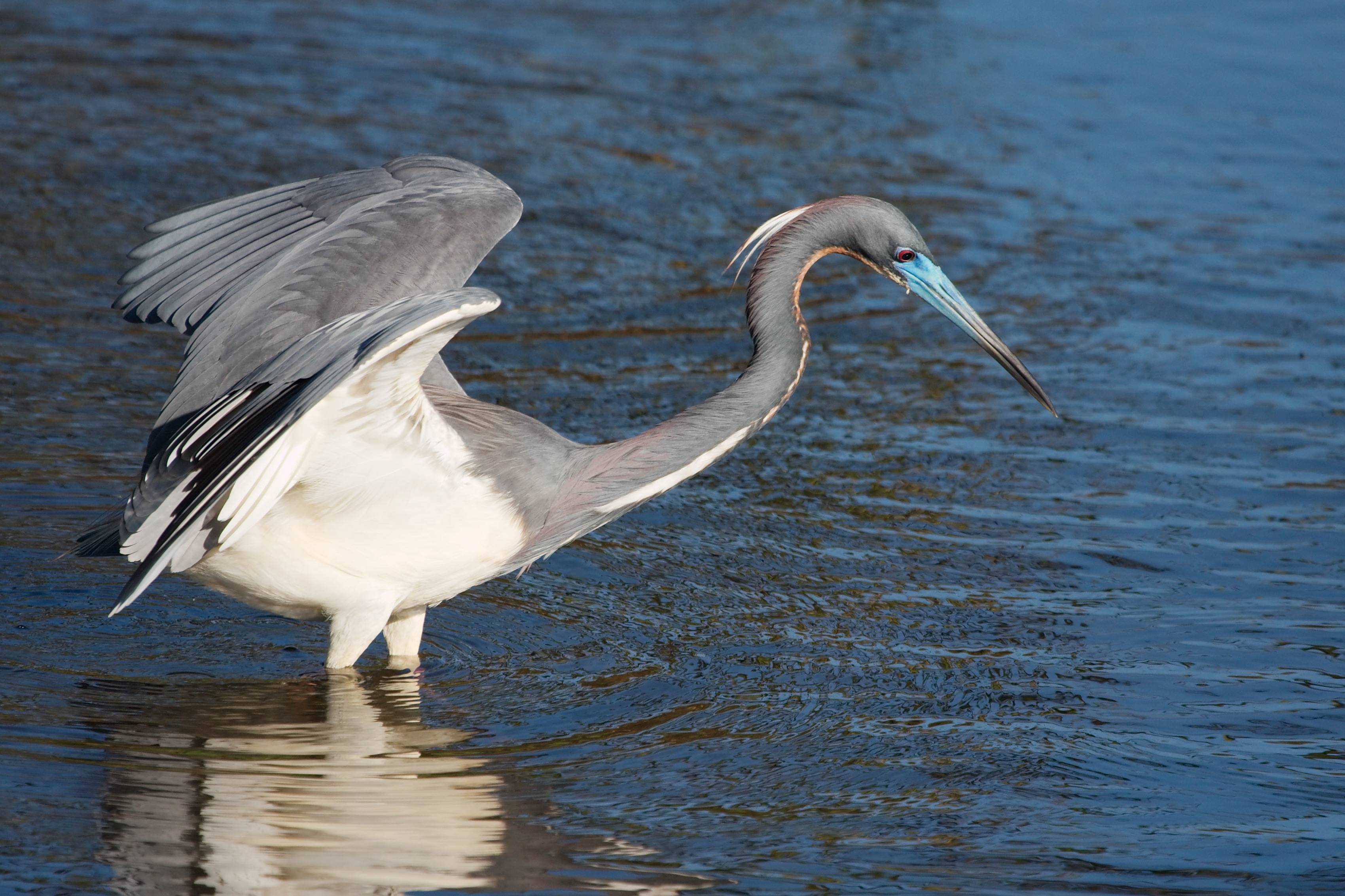
Then, while trudging back to the car, there was a plum-colored blue blob standing on the sand. A Great Blue Heron--no, it was a Tri-colored Heron. I had never seen one of those. That's because you don't, apparently, ever see many of them here. I think I actually gasped. It was the most elegant, graceful, improbably plumaged creature you could possibly hope to see while attempting not to gag because of a pesilential miasma. Utter anthropomorphizing on my part, but to me it looked like it was all dressed up for a formal dinner dance. Ready for the breeding season with a sweeping swatch of white plumage at the back of the neck. The three colors so subtle in the late-afternoon light: soft  blue, creamy white like good vanilla ice cream, and a reddish blush on the neck. It was to be but a fleeting flash of beauty. Up it rose on its chopstick-legs, and it was gone--briefly mobbed by gulls as it departed--out to roost somewhere for the night.

Photograph taken by Dori, Wikimedia Commons