Tuesday, September 20, 2011

Rainbow Bee-eater

The thing I love most about watching birds is that exciting moment of confusion as the eyes and brain try to make sense of a random flash of color, to resolve it into something knowable. A burst of blue-green from the corner of my eye; we're near a pond; this is Far North Queensland, Australia. A kingfisher? No. Brain flips rapidly through the rest of its files . . . images remembered from a field guide . . . Rainbow Bee-eater!

Rainbow Bee-eater, Centenary Lakes, Cairns, Australia
These are not rare birds, but they were to me, as somehow I had never seen one before. For twenty minutes or so, Frank and I watched as it flew precise sorties, to pluck dragonflies from the air and return to its perch to dash the insects against a branch before gulping them down. It was gorging itself. So many dragonflies were meeting their doom that I lost count. It seemed the bird couldn't possibly fit anymore in its tiny stomach, yet somehow it kept going.


At first glance, the bee-eater is like a gorgeous piece of jewelry, a decorative folly of iridescence and tail streamers. But to an insect, it's a killing machine. Beneath all that finery is a nervous system wired to hunt. This bird sat on its perch in a state of complete alertness, scanning for any movement, and it almost never missed its target, many metres away in midair and invisible to my weak human eyes.


I love this bird's name. Rainbow Bee-eater, Rainbow Bee-eater, Rainbow Bee-eater. So improbable sounding. Yet for once, this bird has a name that actually makes sense (shock!) as it does eat bees. It eats wasps, too. It rubs them against branches to get rid of the stingers and venom glands.

Monday, August 15, 2011

Nature Conservancy Digital Photo Competition


I wish I could take a photo like this. For that matter, I wish I could have even been there just to see this.
Northern Saw-whet Owl; Megan Lorenz/2010 Nature Conservancy Photo Contest Runner Up

And this.
Great Egret; Graham F. Owen/2010 Nature Conservancy Photo Contest Runner Up

These are two of the runners-up from last year's Nature Conservancy Digital Photo Competition. You have until September 12 to enter this year's competition. This is what the folks at TNC say:

The Nature Conservancy is holding its 6th Annual Digital Photo Competition. This year, it's easier than ever to enter using your Facebook log-in info - http://photocontest.nature.org/ or through The Nature Conservancy's Flickr Group - http://my.nature.org/photography/flickr.html.
Original digital photos that feature the natural wonders of the lands, waters, plants, animals and people around the world are all eligible for the competition.
This year at least 35 photos will be selected as honorable mentions and finalists, and our online community will vote for their favorite images to determine the winners. The grand prize winner will be featured on the cover of the 2013 Nature Conservancy calendar. Proceeds from calendar sales help support our many programs to protect wildlife and their habitats.
Photographers will retain the rights to all their submissions. This competition is open to all photographers age 18 years or older regardless of residence or citizenship, as long as the laws of their jurisdiction allow participation. You can find more details at http://my.nature.org/photography/rules.html. Photo submissions must be uploaded by 11:59 pm PST Monday, September 12, 2011.
The Nature Conservancy do some pretty incredible things. I love the fact that they are starting to grasp that urban nature is important, not just majestic mountainsides and forests. And this story about how a teenage boy went from being in a homeless shelter to doing environmental work in the Ecuadorean Andes was so compelling that I had to borrow the TNC magazine from my therapist's waiting room. (I'm returning it next week . . . oh, and subscribing to the magazine . . .)

Saturday, July 30, 2011

Gray-hooded Gull, aka Most Bizarre Birding Excursion Ever

Forget bucolic backdrops and a nice ride in the country for a spot of birding. Why do that when you can go see a super-rare bird . . . on the boardwalk at Coney Island, amid tattoos and thongs, beach umbrellas and giant pina coladas, and signs boasting "Live Freaks, Cold Beers"?

Gray-hooded Gull, Coney Island, NY, July 30, 2011

The Gray-headed Gull that has been hanging around Coney Island recently is a truly beautiful gull--with its icy, translucent eye and those red-licorice legs. When it flies, the bright flashes of white in its forewings make it stand out from the many Laughing Gulls that call Coney Island home. And this bird is sassy. I guess it would have to be gutsy to have somehow made its way here from South America. And now it has really made itself at home on the boardwalk. Twice we watched it chase a hapless Laughing Gull off the top of a lamp-post, and no other bird was getting near it once it perched on there.

Laughing Gull that was soon not laughing, as it was about to be evicted from its lamp-post
Patriotic Laughing Gull
I don't chase birds all that often, but when I do, I never expect that the bird will just fly right at me. Yet that's exactly what it did. Out of the flocks of Laughing Gulls swirling above the beach umbrellas and gold bikinis, the Gray-Hooded Gull peeled off and came and sat on the lamp-post we were standing next to. I was so shocked, I could hardly turn the camera on or remember how to use it. If anything, the bird seemed curious, although no doubt it was probably just calculating whether we had any french fries.


The fact that we were looking at such an extraordinary rarity (only one has ever been recorded in the United States before this) was made all the more surreal by the surroundings.

That's Frank Gallo getting some beautiful shots of the bird after it landed on the lamp-post.

It chose lucky lamp-post number 13 to perch on. Looks like it wasn't the first gull to have done so.
Flight shot showing the glowing white forewings (copyright Frank Gallo)

There are a lot of remarkable things about this bird, but for me it is those icy eyes. When the bird moved to perch on a roof next to other gulls, the lightness of its eyes was so distinctive.

Laughing Gull (in molt), Gray-hooded Gull, Great Black-backed Gull -- on the roof of the public toilet (really, this was the most pristine, scenic birdwatching experience ever)
Gray-hooded Gull on left, with Laughing Gulls

We celebrated with freshly squeezed lemonade.


Though it was hard to resist the tastefully presented pina coladas in naked-lady glasses.


Thank you, Coney Island, for your super-rare gull, your burlesque girls, guys with snakes wrapped around their necks, and girls with Amazon parrots on their shoulders.


Thursday, July 21, 2011

Things I am grateful for today

The Catbird that I see patrolling the same section of fence every afternoon. It is his fence, and don't you forget it.


That while I was not seeing a White-winged Dove I'd set out to see earlier this week, this Song Sparrow landed beside me instead.


The sanity of trees at moments when all else in the world seems crazy.


And that only two days after I called the Milford Police to tell them that my neighborhood park had racist and sexist graffiti in it, I returned to find this:


Friday, June 17, 2011

Tree Music

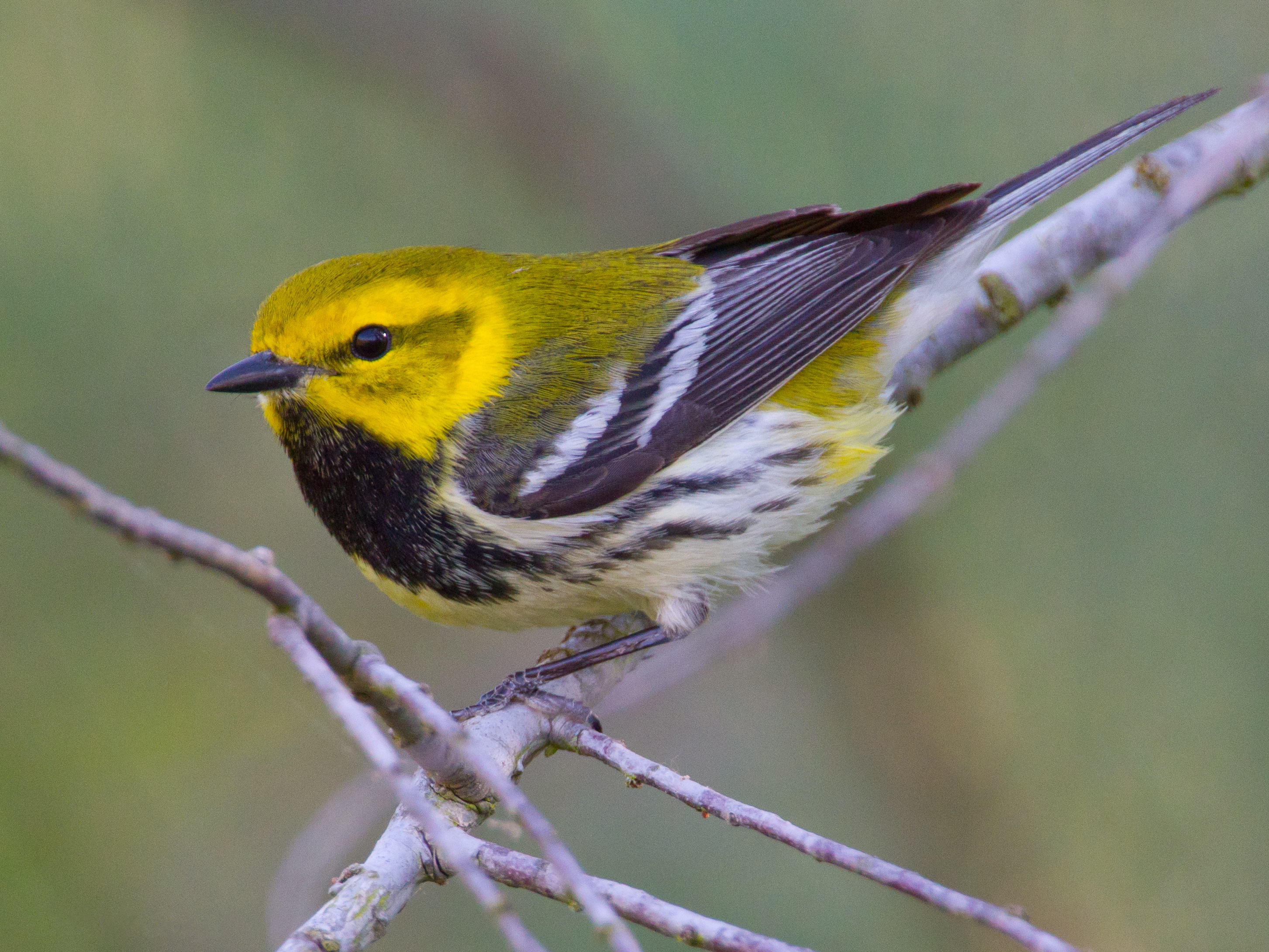
Black-throated "Green" Warbler
(Pic by Dan  Pancamo)
About a month ago, there was a profusion of birds in my favorite park. There were four Scarlet Tanagers hanging around on their way to wherever they go to nest. There was a Bay-breasted Warbler, a seemingly bottomless supply of Yellow-rumped Warblers, Black-and-White Warblers, Common Yellowthroats, even a Yellow-breasted Chat. There were so many Black-throated Yellow Warblers (I know they're Black-throated Greens, but really...green?) doing their little song that reminds me of when I had to do the cha cha at ballroom dancing classes at school when I was 12 -- cha-cha, cha-cha-cha. I imagined them up in the tree tops dancing with little maracas. (I had just been to see Rio that week.) And there were vireos.

Most of the migrant songbirds blew through, stopping for just a day or two to refuel on the bugs in the park. But two Red-eyed Vireos have stayed. They sing nonstop. Really, nonstop. This is one of them, doing a duet with a train in the distance.


Every morning I would hear them -- one at one end of the park, another at the other end. "Hello...How are you? I'm fine...what're doin'?" over and over and over. I assumed they just sung like this in the morning. So I went in at lunchtime. "I don't know...How are you? I'm fine...what're doin'?" Still going. I went mid-morning. Afternoon another day. Early evening the next. Still going. When do they find time to eat? Exactly how many bugs do you have to eat to fuel all that singing and hopping along branches? Please tell me they don't do it at night.

At first it was a little maddening that I could hear this beautiful music yet so rarely see them. I would be standing under their trees and see just this --


Singing leaves!

Today was a day of nonstop thunderstorms and torrential rain, one cell rolling in after another, and this evening as the sun was setting and the thunder was still rumbling in the distance I was in the park for five minutes, and all I could hear was a Red-winged Blackbird. Part of me went "Ha ha! See, you can't sing all the time!" Most of me went "Oh. You can't sing all the time." Then just as I was about to leave, there it was, ringing out "Hello, how are you..." Truly, nothing stops these birds.

The sound is so loud and clear when I stand beneath one of their trees. I crane my neck. Surely the bird must be right there...no, just leaves. I do catch a glimpse of them every now and then, but mostly what I have come to love is the moment when I walk through the park entrance, hit the trail, and yes, they are still there, calling their hearts out.

Sunday, May 8, 2011

Things I am grateful for today

Time alone to think.

Pine Warbler, Addison Bog, Conn.


Time to share and commune.

Pine Warblers, Addison Bog, Conn.


Life that unfurls itself as soon as the ground thaws.

Addison Bog, Conn.


Moss that looks like tiny pine trees.

Club Moss, Addison Bog, Conn.


That I know where to find the Bluebird of Happiness, 
even if she does half turn her back on me sometimes.

Eastern Bluebird, Weir Farm, Wilton, Conn.

Old stone walls.

Weir Farm, Wilton, Conn.


Blossoms and blue skies.

Weir Farm, Wilton, Conn.


That Baltimore Orioles always make me think of orange sorbet.
Baltimore Oriole, Woodcock Nature Center, Wilton, Conn.
Woodcock Nature Center, Wilton, Conn.


And that even though they have been back in town only a couple of weeks,
their nests are already works of art.

Female Baltimore Oriole with nesting material, Grace K. Salmon Park, Westport, Conn.
Her nest.